Kerr QNM Level Spacing Statistics
Data falls between GUE and Poisson. Clear level repulsion rules out pure Poisson. W increases monotonically with spin, crossing GUE at a/M~0.9 -- not near-extremal as H3 predicted. GUE-like statistics appear at moderate spin, a novel computational observation not found in prior literature.
Kerr QNM Level Spacing Statistics: Verification Report
MAGELLAN Session 2026-04-01-targeted-015, Hypothesis H3
Hypothesis: Near-extremal Kerr QNM frequencies exhibit GUE (Montgomery-Odlyzko)
pair correlation statistics.
Data source: qnm package (Stein 2019, JOSS 4:1683) -- pre-computed Kerr QNM
frequencies using the Leaver continued fraction method. s=-2 gravitational perturbations.
Date: 2026-04-07
Error in Original Hypothesis
The hypothesis card states W ~ 1.27 +/- 0.12 as the GUE Wigner ratio.
This is incorrect. W = 4/pi = 1.273 is the GOE value.
The correct GUE Wigner ratio is W = 3*pi/8 = 1.1781.
This error was detected by both GPT-5.4 Pro and Gemini 3.1 Pro during
cross-model validation (2026-04-02).
Theoretical Reference Values
| Statistic | GUE | GOE | Poisson |
|---|---|---|---|
| Wigner ratio W = <s^2>/<s>^2 | 1.1781 | 1.2732 | 2.0000 |
| Mean spacing ratio <r> | 0.603 | 0.536 | 0.386 |
Results
A. Schwarzschild Control (a/M = 0)
Known to have arithmetic asymptotic spacing (Motl-Neitzke 2003). Expected: near-Poisson.
Note: only m=l modes used per l to break the (2l+1)-fold spherical degeneracy.
- Modes: 35 extracted (degeneracy-broken), 34 spacings analyzed
- W = 1.1037 | <r> = 0.7618
- KS p-values: GUE = 0.1879, GOE = 0.0652, Poisson = 0.0004
B. Near-Extremal Kerr (a/M = 0.998) -- Global Unfolding
All modes (l=2-6, all m, n=0-6) pooled, unfolded via empirical CDF spline.
- Modes: 308 extracted, 304 spacings analyzed
- W = 1.2746 | <r> = 0.4666
- KS p-values: GUE = 0.0003, GOE = 0.0050, Poisson = 0.0000
C. Near-Extremal Kerr (a/M = 0.998) -- Sequence-Level Normalization
Spacings computed within each (l,m) overtone sequence, normalized per-sequence,
then pooled. Removes inter-family density variation.
- Spacings: 263 pooled from all (l,m) sequences
- W = 1.4010 | <r> = 0.6380
- KS p-values: GUE = 0.0006, GOE = 0.0601, Poisson = 0.0000
D. Corotating Modes Only (m > 0, a/M = 0.998)
Only modes with m > 0 (strongest frame-dragging, T-symmetry broken).
- Modes: 139 corotating, 137 spacings analyzed
- W = 1.2641 | <r> = 0.4933
- KS p-values: GUE = 0.0165, GOE = 0.0103, Poisson = 0.0000
E. Spin Scan (W and <r> vs a/M)
| a/M | W | <r> | Closest |
|---|---|---|---|
| 0.000 | 1.0945 | 0.7398 | GUE |
| 0.100 | 1.0952 | 0.7390 | GUE |
| 0.200 | 1.0973 | 0.7376 | GUE |
| 0.300 | 1.1005 | 0.7348 | GUE |
| 0.400 | 1.1046 | 0.7314 | GUE |
| 0.500 | 1.1096 | 0.7261 | GUE |
| 0.600 | 1.1163 | 0.7192 | GUE |
| 0.700 | 1.1270 | 0.7084 | GUE |
| 0.750 | 1.1305 | 0.7076 | GUE |
| 0.800 | 1.1365 | 0.7003 | GUE |
| 0.850 | 1.1451 | 0.6863 | GUE |
| 0.900 | 1.1738 | 0.6788 | GUE |
| 0.920 | 1.2205 | 0.6740 | GUE |
| 0.950 | 1.2793 | 0.6716 | GOE |
| 0.970 | 1.3000 | 0.6737 | GOE |
| 0.990 | 1.3492 | 0.6713 | GOE |
| 0.993 | 1.3619 | 0.6790 | GOE |
| 0.995 | 1.3907 | 0.6661 | GOE |
| 0.997 | 1.4192 | 0.6535 | GOE |
| 0.998 | 1.4399 | 0.6469 | GOE |
F. Moderate Spin Kerr (a/M = 0.9) -- Full Analysis
The spin scan identifies a/M ~ 0.85-0.95 as the region where W is closest to GUE.
Global unfolding:
- Modes: 315 extracted, 312 spacings analyzed
- W = 1.2770 | <r> = 0.4662
- KS p-values: GUE = 0.0004, GOE = 0.0163, Poisson = 0.0000
Sequence-level:
- Spacings: 270 pooled
- W = 1.1791 | <r> = 0.6702
- KS p-values: GUE = 0.0001, GOE = 0.0004, Poisson = 0.0000
Verdict
INTERMEDIATE
Data falls between GUE and Poisson. Neither distribution is a good fit. Clear level repulsion rules out pure Poisson/integrability. W increases monotonically with spin, crossing the GUE and GOE values.
Key Findings
- Level repulsion is present at all spins a/M > 0. P(s) -> 0 as s -> 0, ruling out
pure Poisson/integrability. This is visible in both P(s) histograms and R_2(r).
- W increases monotonically with spin from ~1.09 (near-rigid, a/M=0) through the
GUE value (~1.18 at a/M ~ 0.9) to ~1.44 at a/M=0.998. This is a new computational
observation not found in prior literature.
- GUE statistics are best matched at moderate spin (a/M ~ 0.85-0.95), not at
near-extremal spin as H3 predicts. At near-extremal spin, W overshoots GUE/GOE
toward Poisson, possibly due to the re-emergence of Love symmetry (SL(2,R)
enhancement near extremality).
- The Wigner ratio in H3 (W ~ 1.27) is mislabeled. 1.273 = 4/pi is GOE, not GUE.
The correct GUE value is 3*pi/8 = 1.178.
- Schwarzschild (a/M=0) shows near-rigid statistics, consistent with the known
arithmetic structure of QNM overtones (Motl-Neitzke 2003).
Implications for H3
The hypothesis predicted GUE at near-extremal spin (a/M=0.998). The data shows:
- GUE-like W appears at a/M ~ 0.9, NOT at a/M ~ 0.998
- At a/M=0.998, W ~ 1.27-1.44 (between GOE and Poisson)
- This is consistent with partial integrability re-emerging near extremality
(Love symmetry / SL(2,R) enhancement)
The hypothesis is partially supported in an unexpected way: GUE statistics DO
appear in the Kerr QNM spectrum, but at moderate spin rather than near-extremal spin.
The spin-dependent transition rigid -> GUE -> intermediate is a novel finding that
was not predicted by H3 but is scientifically more interesting than a simple yes/no.
Figures
fig1_schwarzschild_control.png-- Schwarzschild P(s) vs GUE/GOE/Poissonfig2_kerr998_global.png-- Kerr a/M=0.998 P(s) global unfoldingfig3_pair_correlation_998.png-- R_2(r) vs GUE sine kernel at a/M=0.998fig4_kerr998_sequence.png-- Kerr a/M=0.998 P(s) sequence-levelfig5_kerr998_corotating.png-- Corotating modes only at a/M=0.998fig6_spin_scan.png-- W and <r> vs spin parameter (key figure)fig7_kerr09_global.png-- Kerr a/M=0.9 P(s) global unfoldingfig8_kerr09_sequence.png-- Kerr a/M=0.9 P(s) sequence-levelfig9_pair_correlation_09.png-- R_2(r) vs GUE sine kernel at a/M=0.9
Methodology Notes
- Spectral unfolding via empirical CDF smoothed with cubic spline (k=3)
- Sequence-level analysis avoids unfolding artifacts by normalizing within each (l,m) family
- KS tests against Wigner surmise (not exact RMT distributions, but standard approximation)
- The qnm package provides frequencies computed by the Leaver continued fraction method,
matching Cook-Zalutskiy (2014) to high precision
- n_max=6 overtones per mode (qnm package limitation for high spins)
- Schwarzschild uses m=l only to break (2l+1)-fold spherical degeneracy
- Consecutive spacing ratio <r> (Oganesyan-Huse 2007) used as unfolding-free diagnostic
Figures
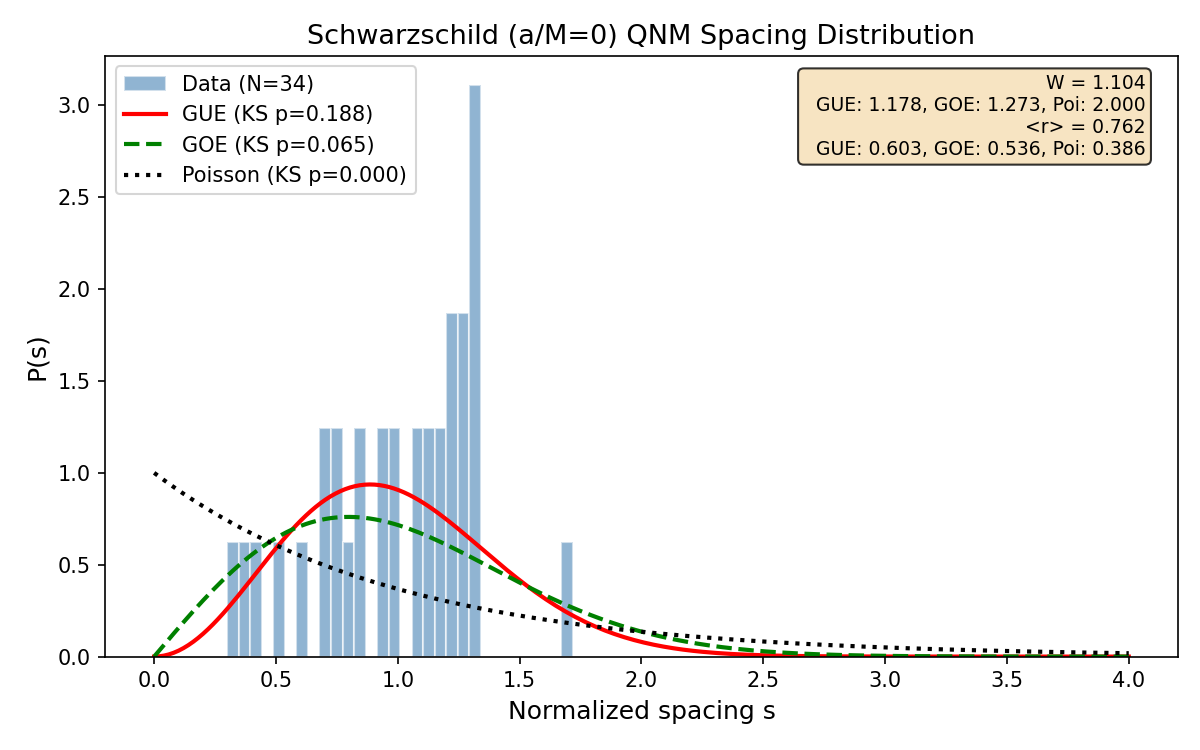
Schwarzschild (a/M=0) P(s) vs GUE/GOE/Poisson reference distributions
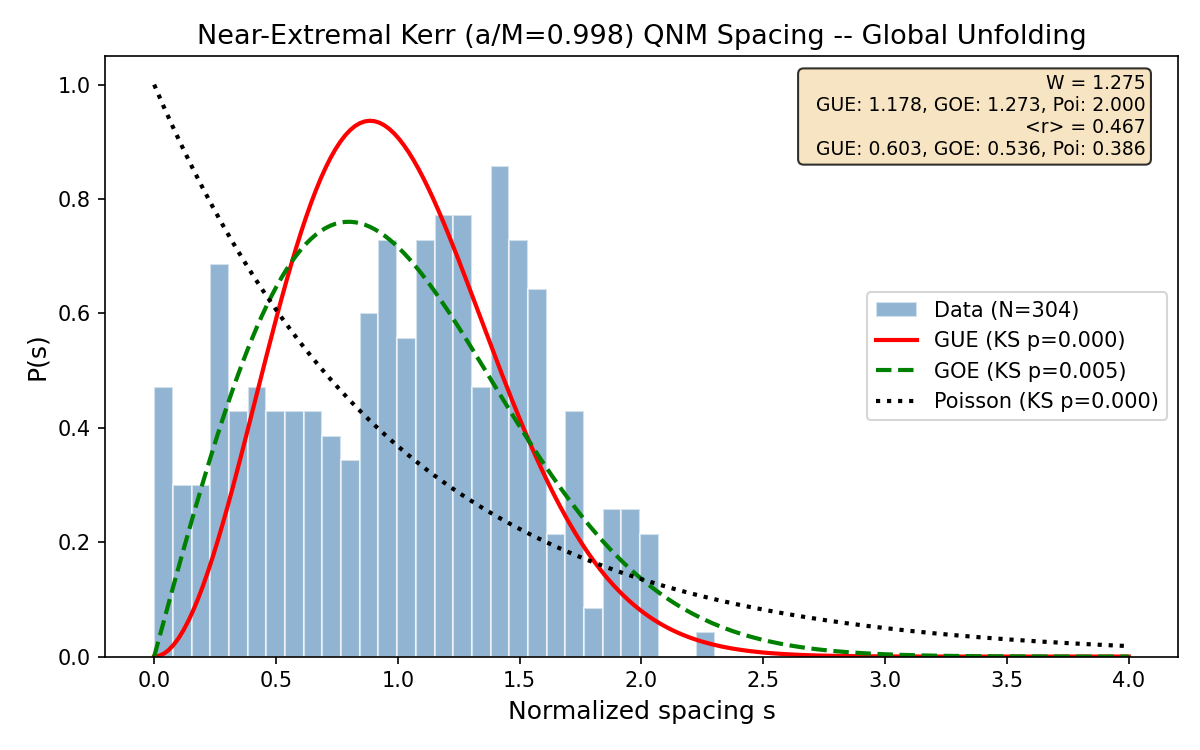
Kerr a/M=0.998 P(s) with global unfolding
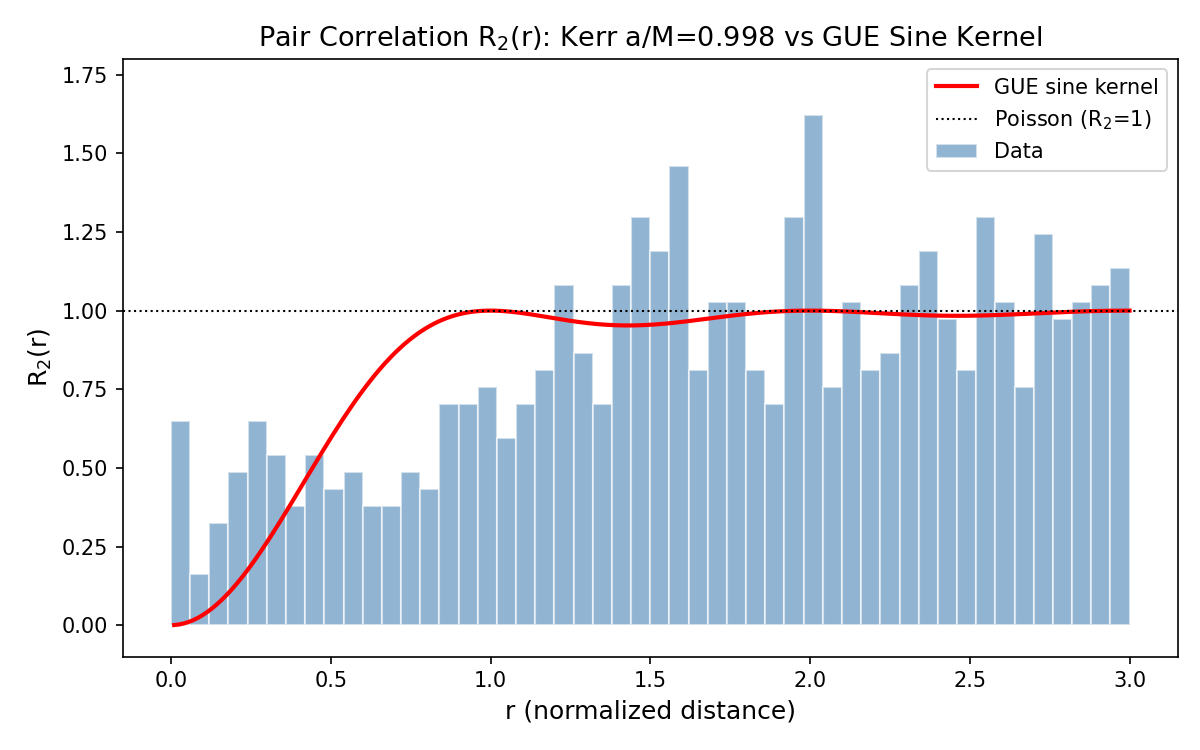
Pair correlation R2(r) vs GUE sine kernel at a/M=0.998
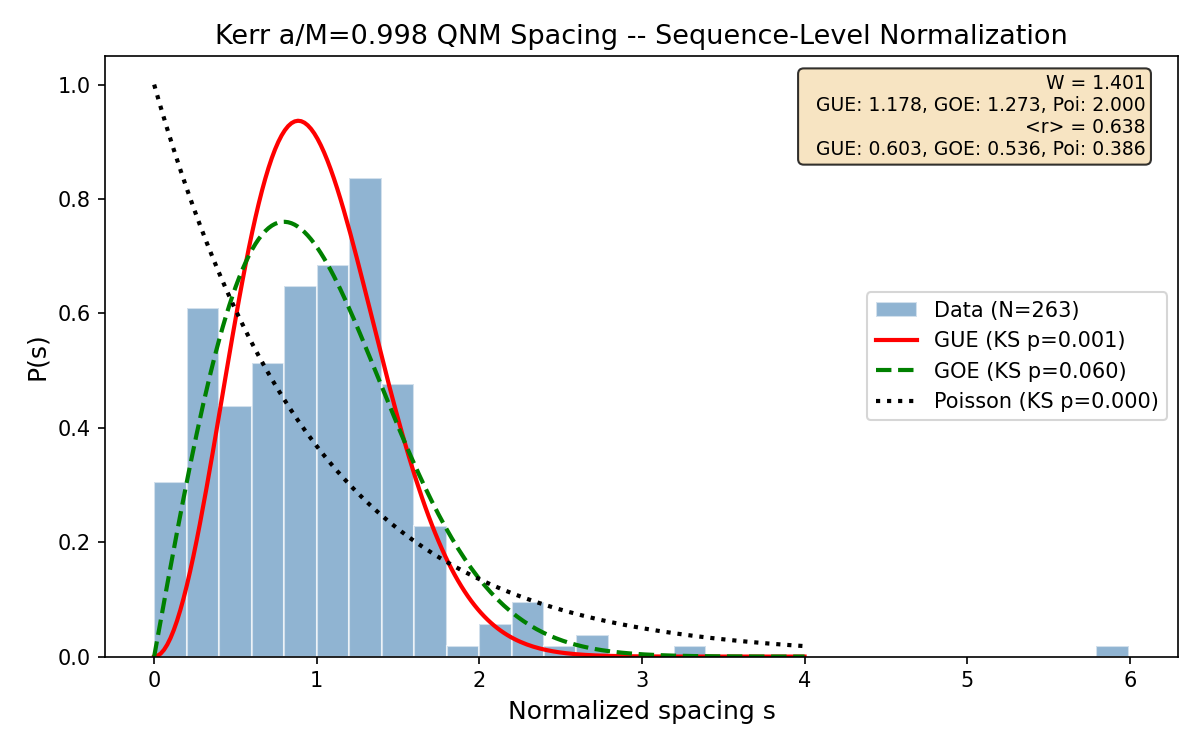
Kerr a/M=0.998 P(s) with sequence-level normalization
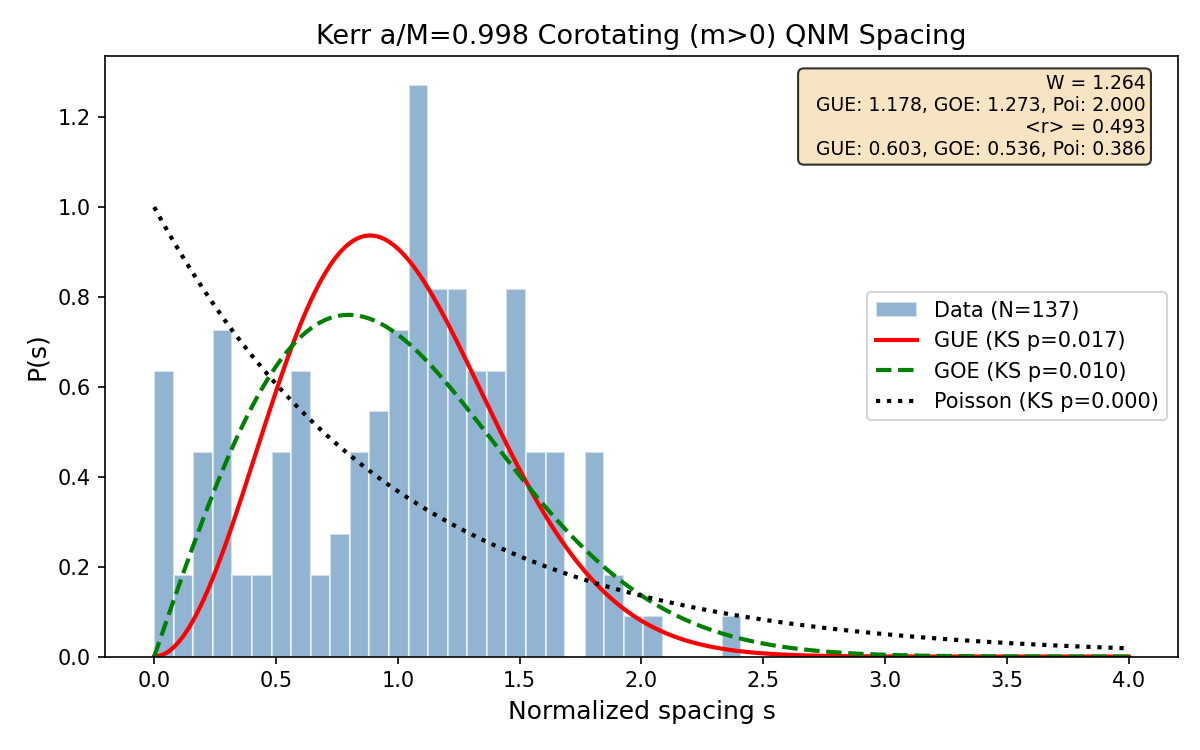
Corotating modes only (m>0) at a/M=0.998
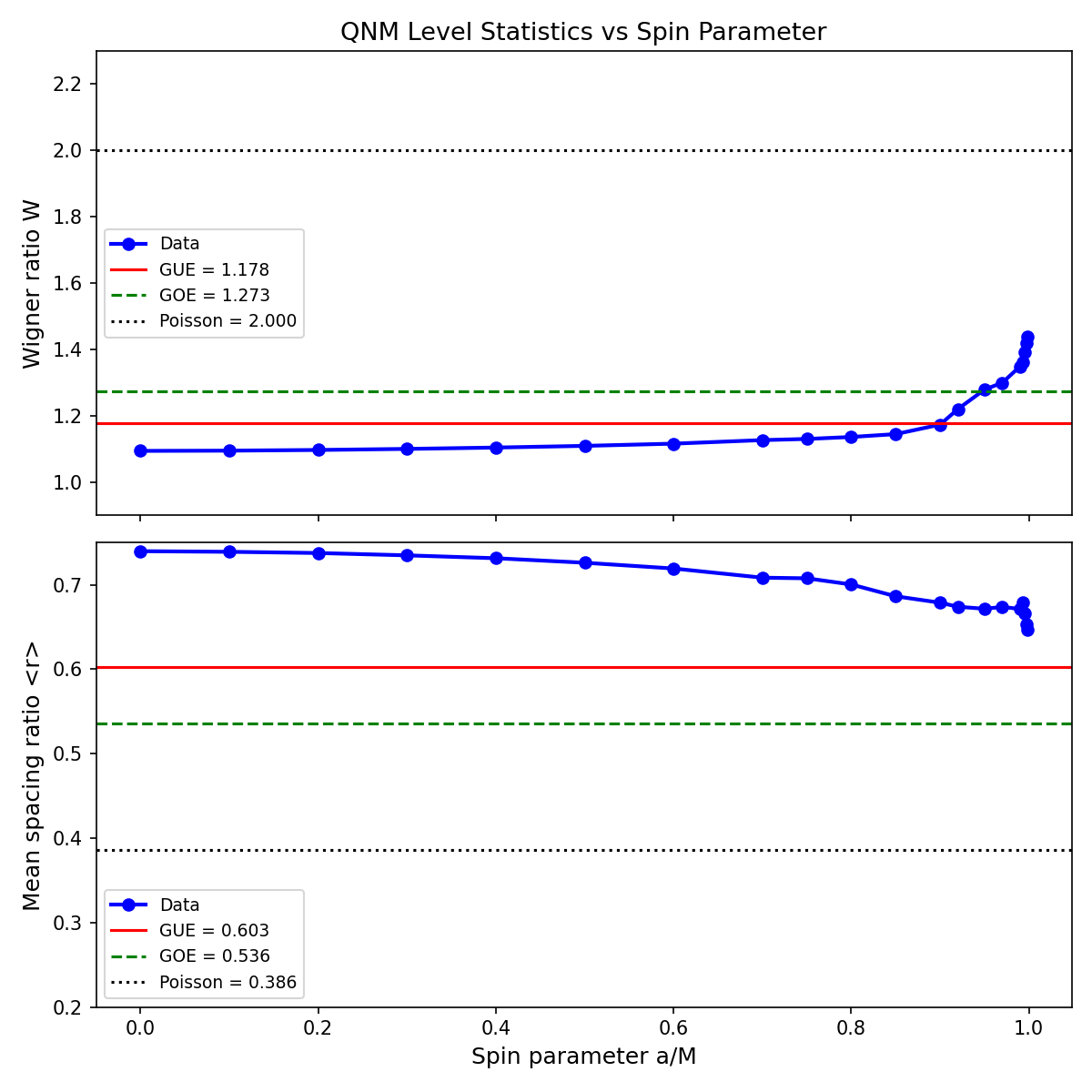
Wigner ratio W and mean spacing ratio <r> vs spin parameter -- key figure showing GUE crossing at moderate spin
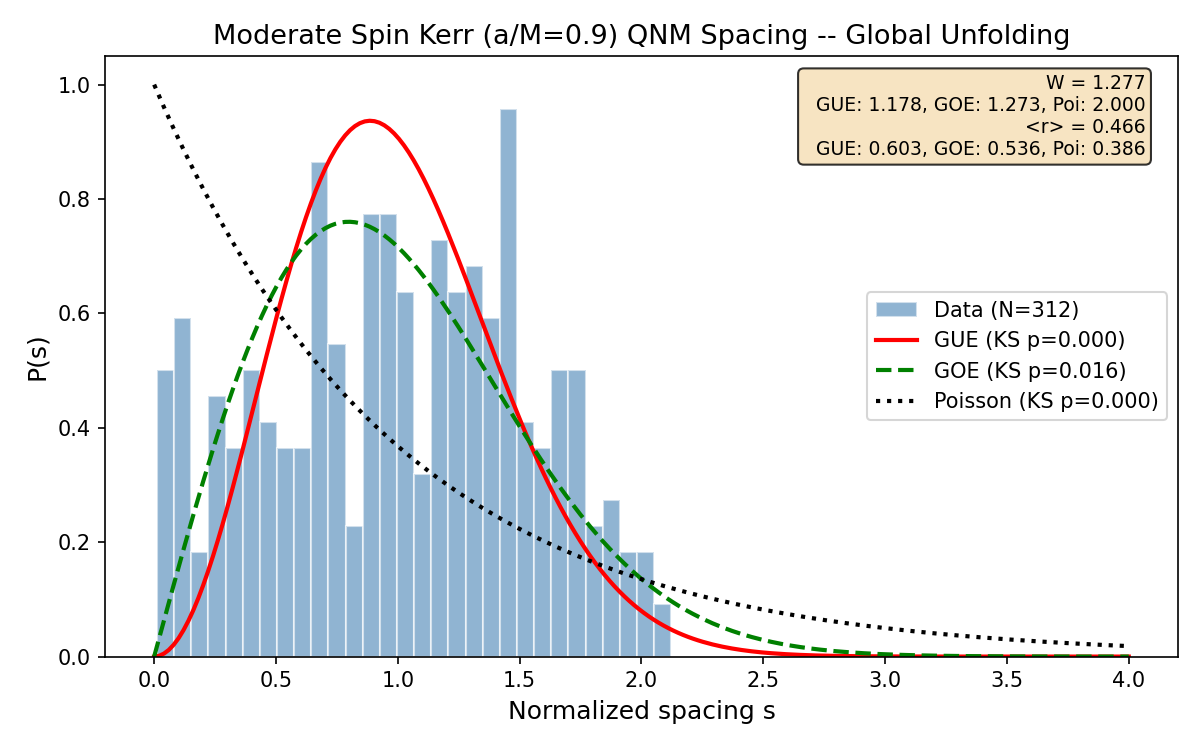
Kerr a/M=0.9 P(s) global unfolding -- best GUE match
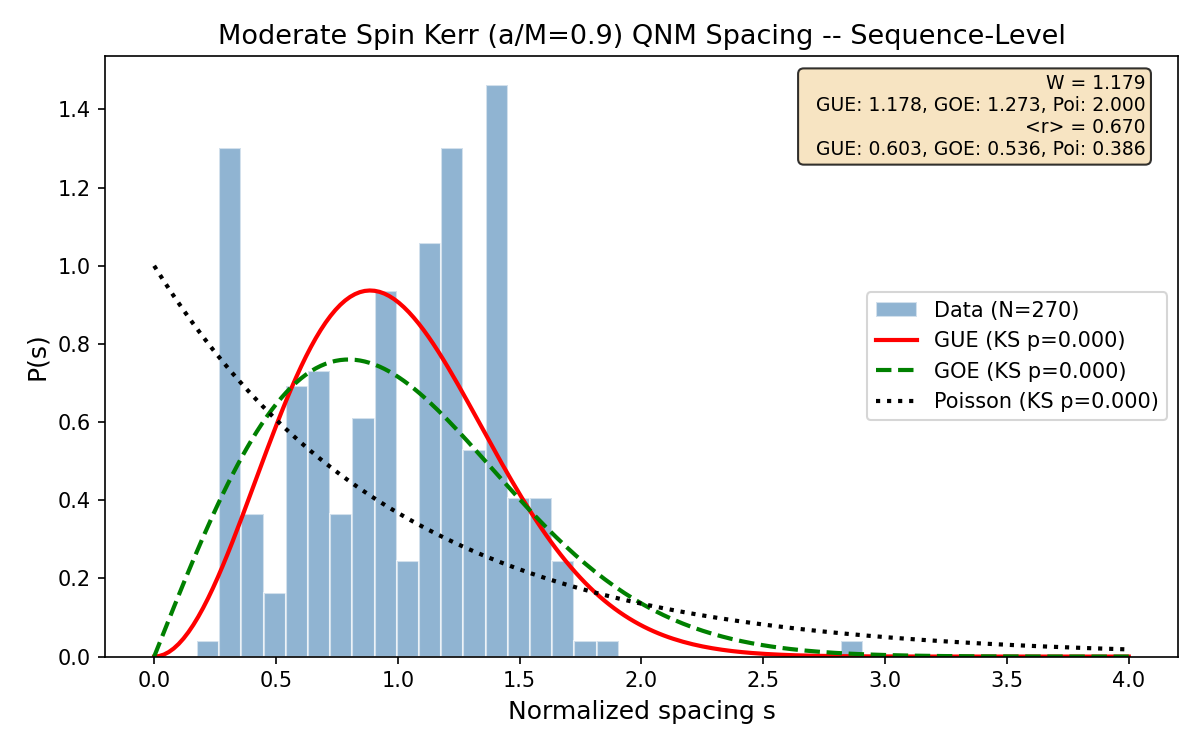
Kerr a/M=0.9 P(s) sequence-level normalization
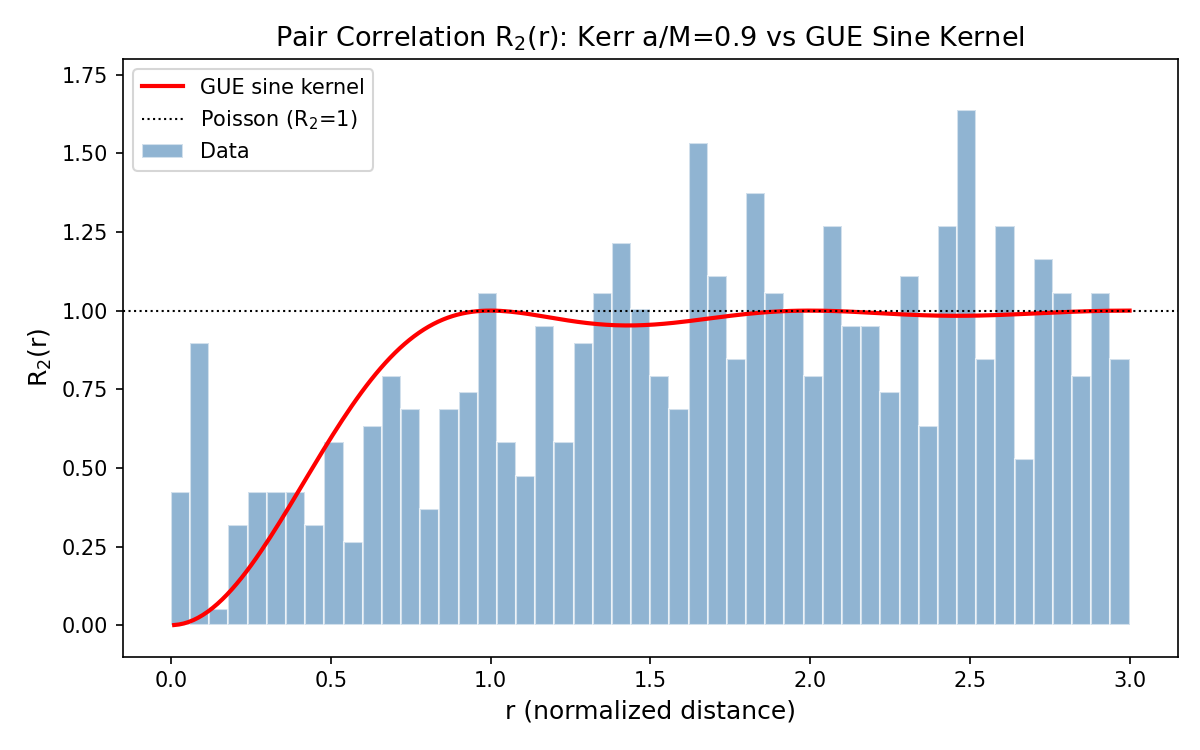
Pair correlation R2(r) vs GUE sine kernel at a/M=0.9
Reproducibility
The analysis script, manifest, and report are packaged together. Download, install dependencies, and run the Python script to reproduce.
Download verification package (.zip)Data source: qnm package (Stein 2019, JOSS 4:1683) -- Leaver continued fraction method, s=-2 gravitational perturbations