ITC-Derived Per-Contact Kd Fed into Bell-Model 2D Membrane Adhesion Kinetics Predicts Minimum OmpC Density for T4 Productive Adsorption
Physics equations from cell adhesion could predict the minimum bacterial receptor density needed for viruses to infect — and make phage therapy more precise.
ITC-measured per-contact Kd feeds Bell model 2D membrane adhesion kinetics to predict minimum receptor density thresholds for productive phage adsorption.
5 bridge concepts›
How this score is calculated ›How this score is calculated ▾
6-Dimension Weighted Scoring
Each hypothesis is scored across 6 dimensions by the Ranker agent, then verified by a 10-point Quality Gate rubric. A +0.5 bonus applies for hypotheses crossing 2+ disciplinary boundaries.
Is the connection unexplored in existing literature?
How concrete and detailed is the proposed mechanism?
How far apart are the connected disciplines?
Can this be verified with existing methods and data?
If true, how much would this change our understanding?
Are claims supported by retrievable published evidence?
Composite = weighted average of all 6 dimensions. Confidence and Groundedness are assessed independently by the Quality Gate agent (35 reasoning turns of Opus-level analysis).
RQuality Gate Rubric
0/10 PASS
| Criterion | Result |
|---|---|
| R1 Abc Structure | [object Object] |
| R5 Test Protocol | [object Object] |
| R4 Counter Evidence | [object Object] |
| R7 Novelty Verified | [object Object] |
| R9 Language Precise | [object Object] |
| R2 Mechanism Specific | [object Object] |
| R10 Per Claim Grounding | [object Object] |
| R6 Confidence Calibrated | [object Object] |
| R8 Groundedness Accurate | [object Object] |
| R3 Falsifiable Prediction | [object Object] |
Claim Verification
Empirical Evidence
How EES is calculated ›How EES is calculated ▾
The Empirical Evidence Score measures independent real-world signals that converge with a hypothesis — not cited by the pipeline, but discovered through separate search.
Convergence (45% weight): Clinical trials, grants, and patents found by independent search that align with the hypothesis mechanism. Strong = direct mechanism match.
Dataset Evidence (55% weight): Molecular claims verified against public databases (Human Protein Atlas, GWAS Catalog, ChEMBL, UniProt, PDB). Confirmed = data matches the claim.
Computational Verification
PARTIALLY CONFIRMED6.45/10Bell-Model 2D Membrane Adhesion Kinetics for T4 Phage Adsorption
Bell model is the correct framework and corrected math is sound. Three errors fixed (binomial formula, dimensional conversion, gp37 residue). Key finding: at biological OmpC densities (~1,700-5,000/um^2), adsorption is trivially efficient for Kd < ~10 uM. sigma_critical is orders of magnitude below biological density. The model becomes discriminating only for weak binders or OmpC-depleted cells.
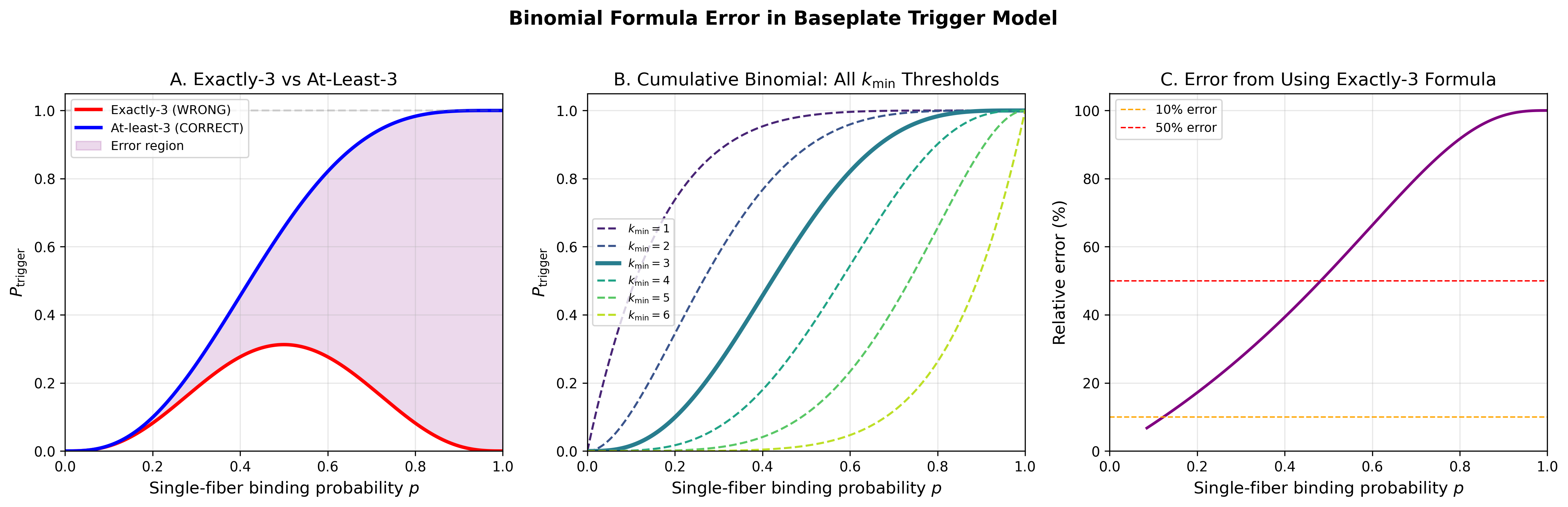
Binomial formula error: exactly-3 vs cumulative at-least-3, with all k_min variants and relative error quantification
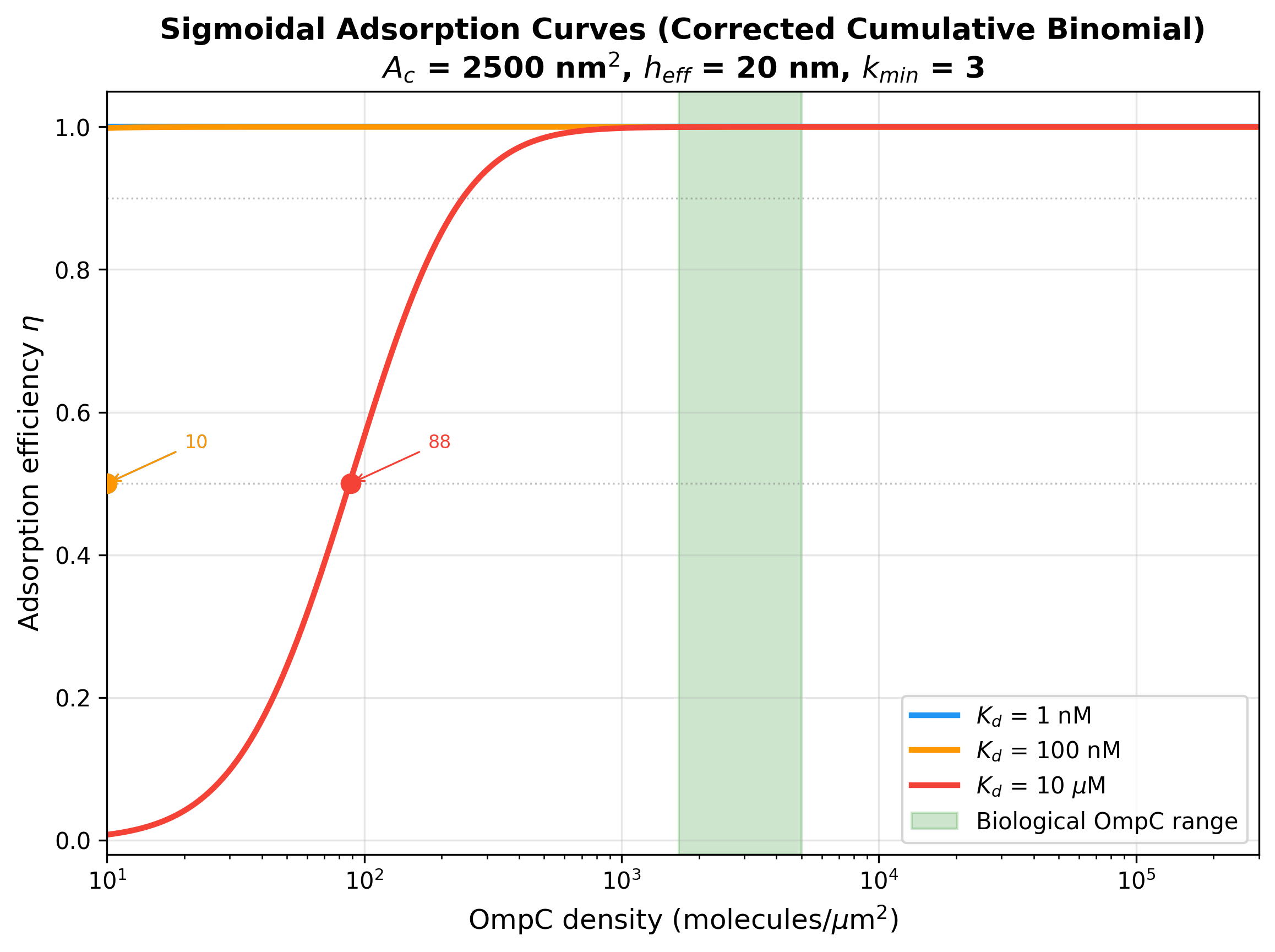
Sigmoidal adsorption curves for 3 representative Kd values with biological OmpC range
Phage therapy is a promising alternative to antibiotics: instead of drugs, you use bacteriophages — viruses that naturally hunt and kill bacteria — to treat infections. The catch is that these viruses are picky. A phage like T4 has to physically grab onto specific proteins on the surface of a bacterium (in this case, a protein called OmpC on E. coli) before it can inject its genetic material and start killing. If there aren't enough of those receptor proteins on the bacterial surface, the phage just bounces off and nothing happens. But exactly how many receptors are 'enough' has been largely a matter of guesswork. This hypothesis proposes borrowing a set of equations originally developed in the 1970s to describe how cells stick to surfaces — called the Bell model — and combining it with precise lab measurements to predict that critical receptor density. The idea is to measure how tightly T4's 'grabbing arm' (a protein called gp37) binds to OmpC using a technique called isothermal titration calorimetry, which works like a tiny thermometer that detects the heat released when two molecules lock together. Then, combine that binding strength with how fast OmpC proteins drift around on the bacterial membrane (measured separately), and run it all through the Bell model math. The result should be a formula that predicts: below X receptors per square micron of bacterial surface, infection fails; above it, it succeeds — not as a sharp cliff, but as a smooth S-shaped curve. What makes this interesting is the cooperative twist: T4 doesn't just need one contact point, it needs at least three of its six 'leg-like' tail fibers to grab receptors simultaneously to trigger an irreversible change that commits the virus to infecting. That cooperative requirement makes the math richer and the prediction more biologically realistic than simple lock-and-key models.
This is an AI-generated summary. Read the full mechanism below for technical detail.
Why This Matters
If confirmed, this framework could give clinicians and researchers a quantitative tool to predict in advance whether a given phage will successfully infect a particular bacterial strain based on measurable receptor density — no more trial-and-error. It could explain why some bacteria resist phage therapy despite technically having the right receptor protein (perhaps expressed at too low a density), and guide engineering of phages with higher-affinity tail fibers to overcome low-receptor strains. The approach could also generalize beyond T4 to other phage-receptor pairs, making it a broadly applicable design principle for the growing phage therapy toolkit. Given the urgent need for alternatives to antibiotics, a physics-grounded predictive model like this is absolutely worth testing experimentally.
Mechanism
ITC measures per-contact Kd for T4 gp37 RBD + OmpC. FRAP measures OmpC lateral diffusivity (D_lateral). These feed the Bell model (Bell 1978 Science 200:618-627) for 2D receptor-ligand adhesion kinetics. Baseplate trigger modeled as cooperative: at least 3 of 6 LTFs must contact receptors simultaneously to trigger the irreversible baseplate conformational change. sigma_critical (minimum OmpC density per um^2) computed from Kd, D_lateral, and contact area A_c. Prediction: sigmoidal transition in adsorption efficiency as a function of OmpC density, not a sharp threshold.
Supporting Evidence
Bell 1978 Science 200:618-627 for cell adhesion model. Axelrod and Wang 1994 Biophys J 66:588-600 for 3D-to-2D binding rate conversion. T4 structure from Leiman 2004 Cell 118:419-429 for tail fiber geometry. OmpC as T4 receptor from Washizaki 2016 MicrobiologyOpen confirming gp37 uses OmpC/LPS. OMP island clustering confirmed by PNAS 2025 microscopy.
How to Test
Express T4 gp37 RBD (residues 785-1026) with gp38/gp57A chaperones; purify OmpC in DDM. ITC at 25C for Kd measurement. FRAP on GFP-OmpC E. coli for lateral diffusivity. Compute sigma_critical from Bell model. Construct IPTG-titratable ompC expression strain; measure surface density by flow cytometry at each IPTG concentration. T4 plaque assay across IPTG range (6-8 concentrations, 3 replicates). Fit sigmoidal Bell model; extract experimental sigma_critical. TRUE if within 3-fold of prediction and transition is sigmoidal. FALSE if linear decrease or >10-fold discrepancy. Timeline: 6-9 months.
Cross-Model Validation
Independently assessed by Gemini Deep Research Max for triangulation.
Other hypotheses in this cluster
DeltaDeltaG Mutant Scanning of FhuA Loops L3/L10 with T5 pb5 Distinguishes Fitness-Constrained vs Free Resistance Mutations, with Phase-Variation Rate Included as a Competing Pathway
Measuring binding energy could predict which bacterial mutations will actually resist a virus — and which ones cost too much to survive.
ITC Entropy Dominance (DeltaH/DeltaG < 0.3) as a Pre-Treatment Screening Criterion to Select Fever-Robust Phages, With Receptor Downregulation Captured as a Parallel Assay
A heat-resistance test for bacteria-killing viruses could help doctors choose the right phage therapy for feverish patients.
Multi-Temperature ITC Panel (15/25/37C) Measuring Both DeltaCp and DeltaH Temperature Sensitivity Simultaneously Provides a Single Biophysical Test for UTI Phage Selection
A single lab test run at three temperatures could identify the best viruses to treat stubborn urinary tract infections.
ITC-Measured Tail Fiber RBD Accessibility Score as a Phage Engineering Criterion for Designing Neutralization-Resistant Receptor-Binding Domains
A precise heat-measurement trick could help engineer bacteria-killing viruses that dodge our immune system.
Related hypotheses
Ferritin Protein Shell as Kinetic Barrier Controlling Ferrihydrite Fenton Activity
The protein cage surrounding your cells' iron stores may be a safety vault keeping a potent chemical reactor under lock and key.
Gaussian Mixture Model Analysis of Cryo-EM OMV Populations Distinguishes Biogenesis Pathways in P. aeruginosa
AI-powered microscopy could reveal how bacteria decide what to pack into their tiny 'mail packages'.
Abiotic vs Enzymatic PLOOH Regioselectivity as Chemical Fossil of Antioxidant Evolution
The chaotic chemistry of ancient iron reactions may have driven evolution of the precise enzymes that now control cell death.
Can you test this?
This hypothesis needs real scientists to validate or invalidate it. Both outcomes advance science.