Detectability of Non-Equilibrium Signatures in the Kinetochore Oscillation
Self-contained synthetic-data power-analysis gate for hypotheses E2-H7 (broken-detailed-balance local probability-current curl certificate) and E2-H11 (trajectory-only entropy-production lower bound). CONFIRMED to machine precision: the 1:2 Lissajous net-circulation cancellation (|net area| 6e-15) and the surviving local curl (recovered -2*omega exactly). STRONGLY FAVORABLE on the binding risk all three validators flagged: detection power against an equilibrium twin is ~99-100% at just 5 cycles, 50 nm localization noise, and entropy production as low as ~3 kBT/cycle, because 2 s cadence over a ~100 s period yields ~50 samples/cycle. Slow independent drift is benign. Graded INTERMEDIATE because idealized rotational-OU simulation cannot stress the systematic threats (velocity-embedding finite-difference parity, correlated nonstationarity, role-labeling) that require real trajectories to settle.
Verification: Detectability of non-equilibrium signatures in the kinetochore DI oscillation
Session: 2026-06-10-scout-033 | Hypotheses: E2-H7 (broken-detailed-balance local probability-current curl certificate) and E2-H11 (trajectory-only entropy-production lower bound) | Verdict: INTERMEDIATE
What this verifies (and what it cannot)
E2-H7 and E2-H11 propose to detect and quantify the non-equilibrium drive of the mitotic
kinetochore directional-instability (DI) oscillation from tracking data, using stochastic-thermodynamics
estimators. The Quality Gate, GPT-5.5 Pro, and Gemini all agreed the load-bearing risk is detectability:
at the real experimental cadence (~2 s) with only a few oscillation cycles per cell and finite localization
noise, can these estimators actually resolve the signal? None of the three executed that test; the hypothesis
itself proposes a "synthetic-data power-analysis gate" as its mandatory first step. This verification IS that
gate. It is self-contained simulation: it establishes whether the method is mathematically sound and
statistically feasible in an idealized regime. It does NOT use real kinetochore data and therefore cannot
settle the real biological claim or the systematic-artifact risks that require real trajectories.
Model
A kinetochore-calibrated 2D rotational Ornstein-Uhlenbeck process (the canonical minimal non-equilibrium
steady state, same structure as Battle 2016 / Gladrow 2016): dx = -(kI + omegaJ)x dt + sqrt(2 D0) dW,
calibrated to period T = 100 s, per-coordinate amplitude R0 = 1000 nm, observation cadence dt = 2 s. The
entropy production rate is analytically known, sigma = 2 omega^2 / k (per cycle 4*pi*omega/k), and the
mean signed-area-rate circulation is -omega * R0^2; both vanish exactly at equilibrium (omega = 0), giving
a clean ground truth and a faithful equilibrium null.
Results
**Part A - the 1:2 Lissajous net-circulation cancellation (E2-H7 core identity): CONFIRMED to machine
precision.** When centromere stretch oscillates at twice the kinetochore frequency, the net signed
circulation of the trajectory is exactly zero (|net area| = 6e-15), while the 1:1 control matches the
analytic -pi*A*B*sin(delta) to 4e-8. This reproduces, and pins down numerically, the insight that a naive
net-circulation test would read "equilibrium-like" on a genuinely driven kinetochore - the reason the
hypothesis is forced onto the LOCAL curl instead. (Independently confirmed earlier by GPT-5.5 Pro and Gemini.)
Part A2 - local curl survives: CONFIRMED. The estimated local probability-current field of the simulated
NESS has a mean curl of -0.128 /s, matching the exact analytic value -2*omega = -0.1257 /s. The local curl is
nonzero everywhere even though the global moment can cancel - exactly E2-H7's claim.
Part B - statistical power: STRONGLY FAVORABLE (refutes the low-cycle-count pessimism). Detection
probability of the driven oscillation against an equilibrium twin is ~99-100% at every tested condition:
as few as 5 cycles, with localization noise up to 50 nm (5% of amplitude), down to entropy production as
low as ~3 k_BT/cycle. The reason is concrete and was missed in the qualitative worry: at 2 s cadence and a
~100 s period there are ~50 samples per cycle, so even 5 cycles is ~250 samples - ample for a pooled
circulation statistic. Handedness (powered-stroke sign) is recovered correctly in essentially all detected
cases. White localization noise averages out of the cross-product estimator in expectation and only mildly
inflates its variance.
Part C - slow-drift stress test: this particular nonstationarity is benign. An independent slow
random-walk drift (up to 300 nm RMS) added to each coordinate does NOT inflate the equilibrium false-positive
rate (stays at/below the nominal 5%) and does not degrade power, because an independent per-coordinate drift
carries no systematic cross-correlation and averages out of the signed-area statistic. Linear detrending is a
cheap, sufficient safeguard.
Interpretation and verdict: INTERMEDIATE
The mathematical core of E2-H7 (net cancellation + surviving local curl) is confirmed exactly, and the
statistical feasibility that all three validators flagged as the binding risk is, in the idealized regime,
not a problem at all - the method has ample power at realistic kinetochore sampling. This is a genuinely
useful, decision-relevant result: it removes the single most-cited reason to doubt the hypotheses.
It is graded INTERMEDIATE rather than CONFIRMED because the idealization does not stress the threats that a
clean rotational-OU model cannot represent and that GPT-5.5 Pro specifically flagged: (1) the (b, db/dt)
velocity embedding, where finite-difference velocity from noisy position can manufacture spurious
irreversibility; (2) correlated / phase-shifted nonstationarity (not the benign independent drift tested
here); (3) role-labeling by velocity sign baking the arrow of time into the statistic; (4) metaphase
nonstationarity of the oscillation amplitude and period. These are systematic, not statistical, and can only
be settled on the real Burroughs/McAinsh (PMID 26460545) or RPE1 lattice-light-sheet trajectories with proper
surrogate controls (time-reversal AND phase-randomized), which is the correct next step.
Bottom line for the hypotheses
- E2-H11 and E2-H7 are computationally sound and statistically feasible on data of the resolution that
already exists. The method is not hopeless at low cycle counts - the opposite.
- The remaining risk is implementation artifact control on real data, not detectability.
- This verification establishes method viability; it does not establish that the kinetochore IS measurably
irreversible (that needs the real tracks) nor anything about chromosome-segregation fidelity (which the
hypotheses correctly disclaim lies a factor ~10^4 away on the biochemical tier).
Figures
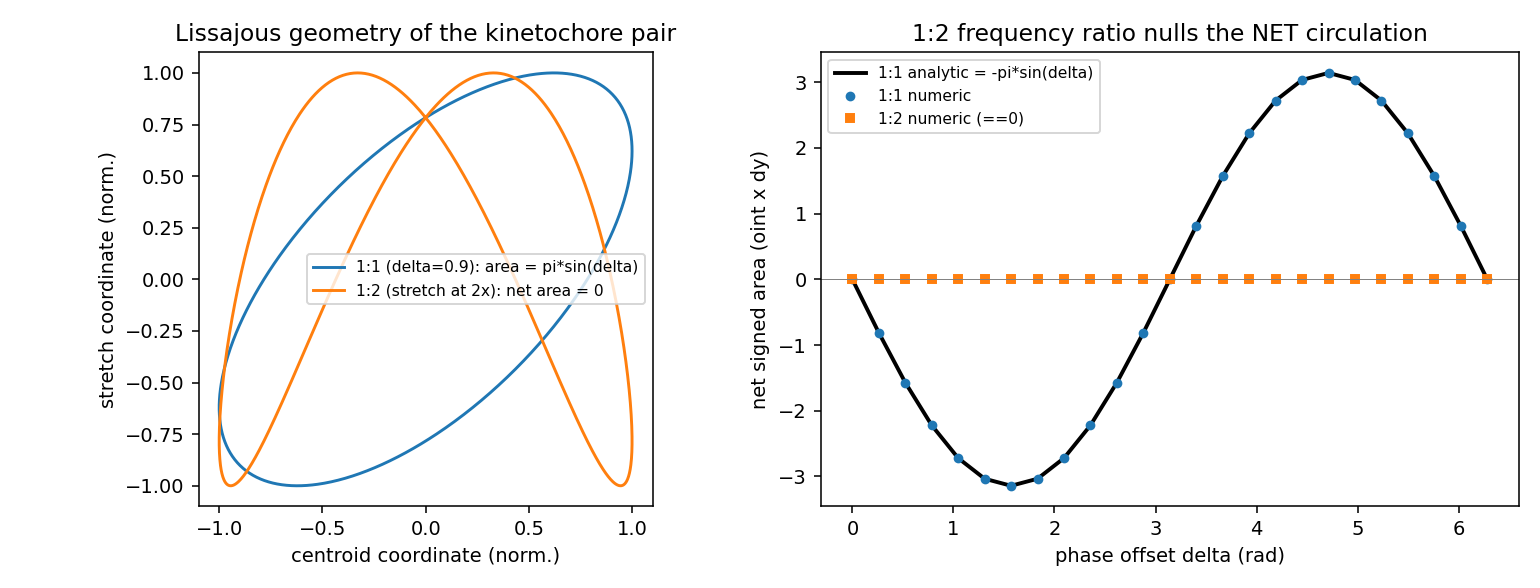
The 1:2 Lissajous net-circulation cancellation (E2-H7 core identity): with stretch at 2x the kinetochore frequency the net signed circulation is exactly zero, while the 1:1 control matches -pi*A*B*sin(delta).
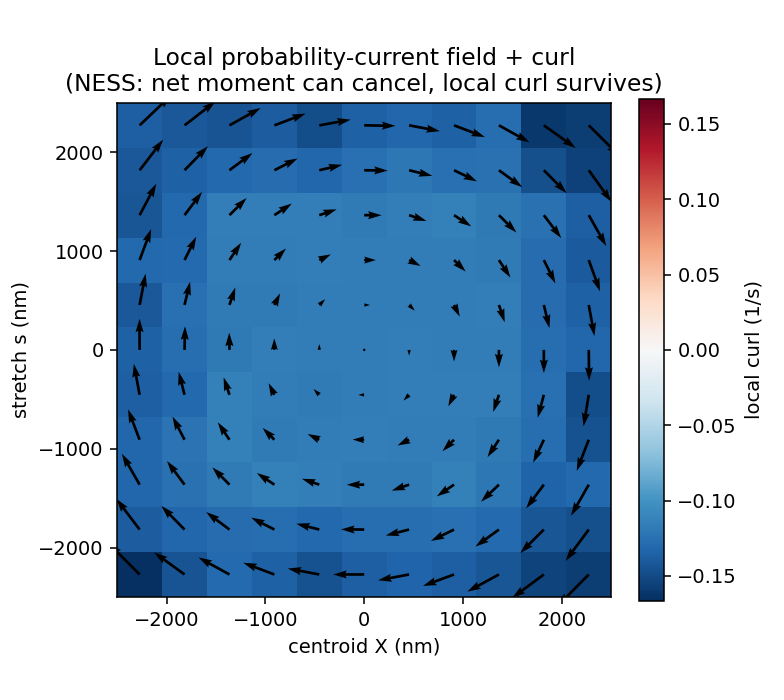
Estimated local probability-current field and its curl for the simulated kinetochore NESS: the local curl survives (mean -0.128/s = -2*omega) even where the global moment cancels.
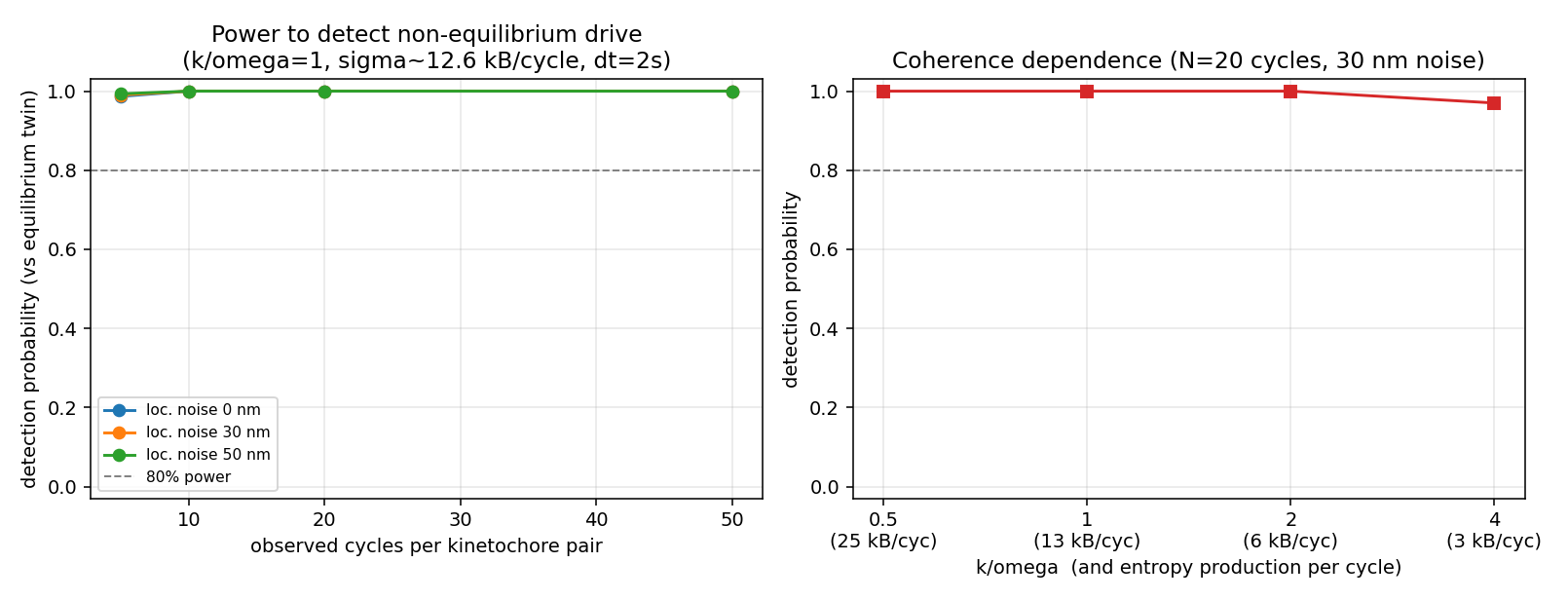
Statistical power to detect the non-equilibrium drive against an equilibrium twin: ~99-100% at as few as 5 cycles and up to 50 nm localization noise, down to ~3 kBT/cycle. Refutes the low-cycle-count pessimism.
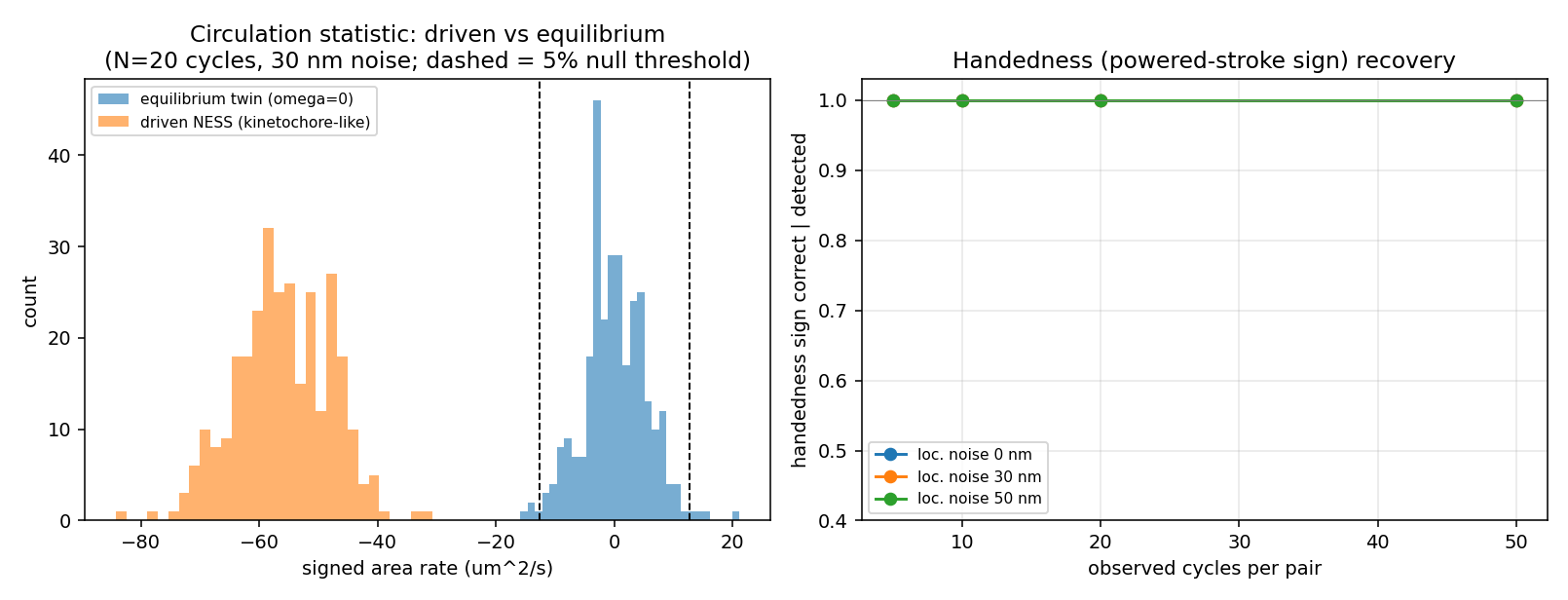
Circulation-statistic distributions (driven NESS vs equilibrium twin) and handedness (powered-stroke sign) recovery.
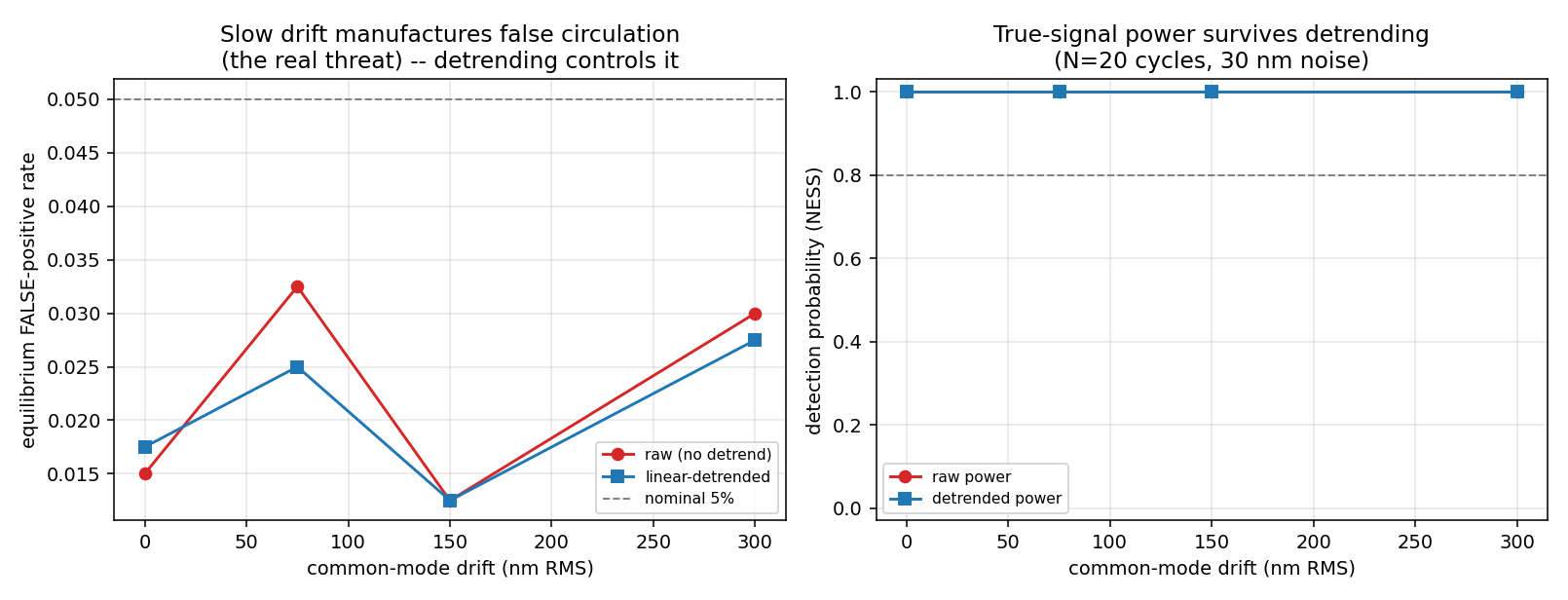
Slow-drift stress test: an independent random-walk drift does not inflate the equilibrium false-positive rate; linear detrending is a sufficient safeguard.
Reproducibility
The analysis script, manifest, and report are packaged together. Download, install dependencies, and run the Python script to reproduce.
Download verification package (.zip)Data source: Self-contained simulation: kinetochore-calibrated 2D rotational Ornstein-Uhlenbeck NESS with analytic ground-truth entropy production; equilibrium-twin null; 300-400 realizations per condition. No biological data used (method-feasibility verification).